by Barbara Franz
How will the world look in 20, 50, 100 years? It seems that there is an ongoing rivalry between two visions of the planet’s future: a socialist paradise versus, in Yuval Harari’s terms, “a network of fortresses” characterized by ultra-nationalist techno-fascist governments. The Office of the Director of National Intelligence published the 2021 Global Tends 2040 in which it describes five future scenarios, two of which fit the network of fortresses and are entitled pointedly “Separate Silos” and “Competitive Coexistence.” (Only one of these five scenarios includes the socialist idea of peaceful international coexistence.) It seems to me that the “network of fortresses” version is becoming reality much faster than imagined. Evidence for this can be found in the Transnational Institute’s most recent study, which reveals that the world’s wealthiest nations are already prioritizing their border built-up and militarization rather than actions to ameliorate climate change and foster peaceful international cohabitation.
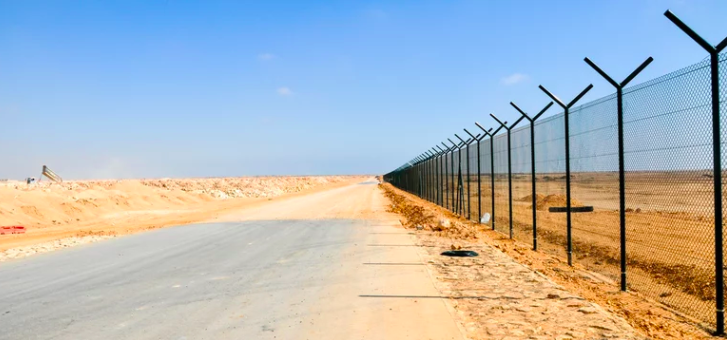
In the Transnational Institute’s report, Todd Miller, Nick Buxton, and Mark Akkerman show that the world’s biggest emitters of green house gases are building a “Global Climate Wall” that aims to seal off powerful countries from refugees, asylum seekers and migrants, rather than addressing the causes of displacement. Seven countries who are responsible for 48% of the world’s historic greenhouse gas (GHG)* emissions—United States, Germany, Japan, the United Kingdom, Canada, France and Australia— collectively spent more than twice as much ($33.1 billion) on border security and immigration enforcement, as on climate change mitigation ($14.4 billion) between 2013 and 2018. The spending on border militarization and securitization by these seven countries rose by 29% between 2013 and 2018. The U.S. spending tripled in that time span, averaging annually $19.6 billion. The budget for the European Union (EU) border agency, Frontex, has increased by a whopping 2,763% since its founding from €5.2 million in 2005 to €460 million in 2020, with €5.6 billion reserved for the agency from 2021 to 2027. The wall-building and militarization of borders in the global North clearly focuses on keeping out the undesired consequences of the expanding global climate catastrophe—refugees and asylum seekers.
However, the perceived crises at the borders have led to a booming border militarization immigration enforcement industry. Miller et al., show that in the time frame from 2008 to 2020 in the U.S., Customs and Border Protection and Immigration and Customs Enforcement issued more than 105,000 contracts worth $55 billion to private companies, such as CoreCivic, Deloitte, Elbit Systems, GEO Group, General Atomics, General Dynamics, G4S, IBM, Leidos, Lockheed Martin, L3Harris, Northrop Grumman, and Palantir. These companies provide anything from private detention facilities, surveillance technology, biometric systems, and data bases to armored transport and drones.**
According to Chi Xu et al., who used data from the US National Oceanic and Atmospheric Administration in their study, by 2070 one to three billion people are projected to live in climate conditions outside of those that have sustained human life for 6,000 years. The authors’ analysis shows that, if we continue living with a “business as usual” approach to climate change, in one third of the planet that is currently inhabited, the mean annual temperature will rise to an unbearable 29°C (84.2°F). Right now, 1% of the earth’s surface is a barely live-able hot zone; by 2070, that area might entail up to 19% of the earth’s surface.
The data sets discussed in Miller et al., and Chi Xu et al. exhibit clearly not just how irrelevant the governments of the major powers (all except Australia, located in the global North) consider the pending climate catastrophe to be. They also reveal how misguided and shortsighted it is to continue funding border militarization and surveillance.
No wall or militarized border will keep the inhabitants of the wealthy countries safe. As the current spread of various variants of COVID-19 shows, borders even with sophisticated security apparatus cannot stop global spread and contamination in a capitalist world that relies on the exploitation of labor and resources of the global south. Borders cannot prevent billions of desperate people from entering the global north’s network of fortress states. Instead, international solidarity expressed through climate finance could help mitigate the impacts of the unfolding climate catastrophe and aid countries in adapting to the new reality, including supporting people who need to relocate or to migrate abroad. Yet the richest countries have failed even to keep their pledges of $100 billion a year in climate finance. The latest figures from the Organisation for Economic Co-operation and Development (OECD) reported $79.6 billion in total climate finance in 2019, but according to research published by Oxfam International, once over-reporting and loans rather than grants are taken into account, the true volume of climate finance may be less than half of what is reported by developed countries. Only a more cooperative, less-market-driven approach to climate change will lead to successful mitigation of its effects on the planet, its environment, and its people.
###
*) Miller, Buxton and Akkerman use a historic metric of world’s greenhouse gas (GHG) emissions since 1850. Other authors have calculated similar GHG emission output per state and per capita. The largest historic GHG emitters are also the world’s top border enforcers. The poorest 50% of the world’s population is responsible for just 7% of global emissions, yet developing countries will face 75-80% of the costs of climate change.
**) These companies are usually also involved in what has been referred to as “border externalization,” the outsourcing of immigration control and deterrence activities, usually conducted by border patrol agents, to foreign police or military agents. The U.S. has engaged in border externalization to Latin American countries—e.g.,Mexico (Operation Merida) and Guatemala—and the EU has externalized Frontex’s work to many North African countries, e.g., it has funded border police and immigration detention facilities in Morocco and Libya. Often the actual outsourcing work is done through contract work by private companies, guaranteeing a booming market for these companies.